Gio’ Pomodoro – Deutsche Version
13 Agosto 2026Gio’ Pomodoro – Sculture in granito. 1996-2026 L’esperienza nelle cave dell’Elba
13 Agosto 2026- Press release
- Il racconto dell’isola/The Story of the Island
- Un cuore di pietra per l’isola di Gio’/A Heart of Stone for Gio’’s Island
- Sedile per Due/Seat for two
- Tavola degli Antenati/Table of the Ancestors
- Granito e Ferro/Granite and Iron
- La memoria dell’isola/The memory of the island
- Gio’ Pomodoro (1930-2002)
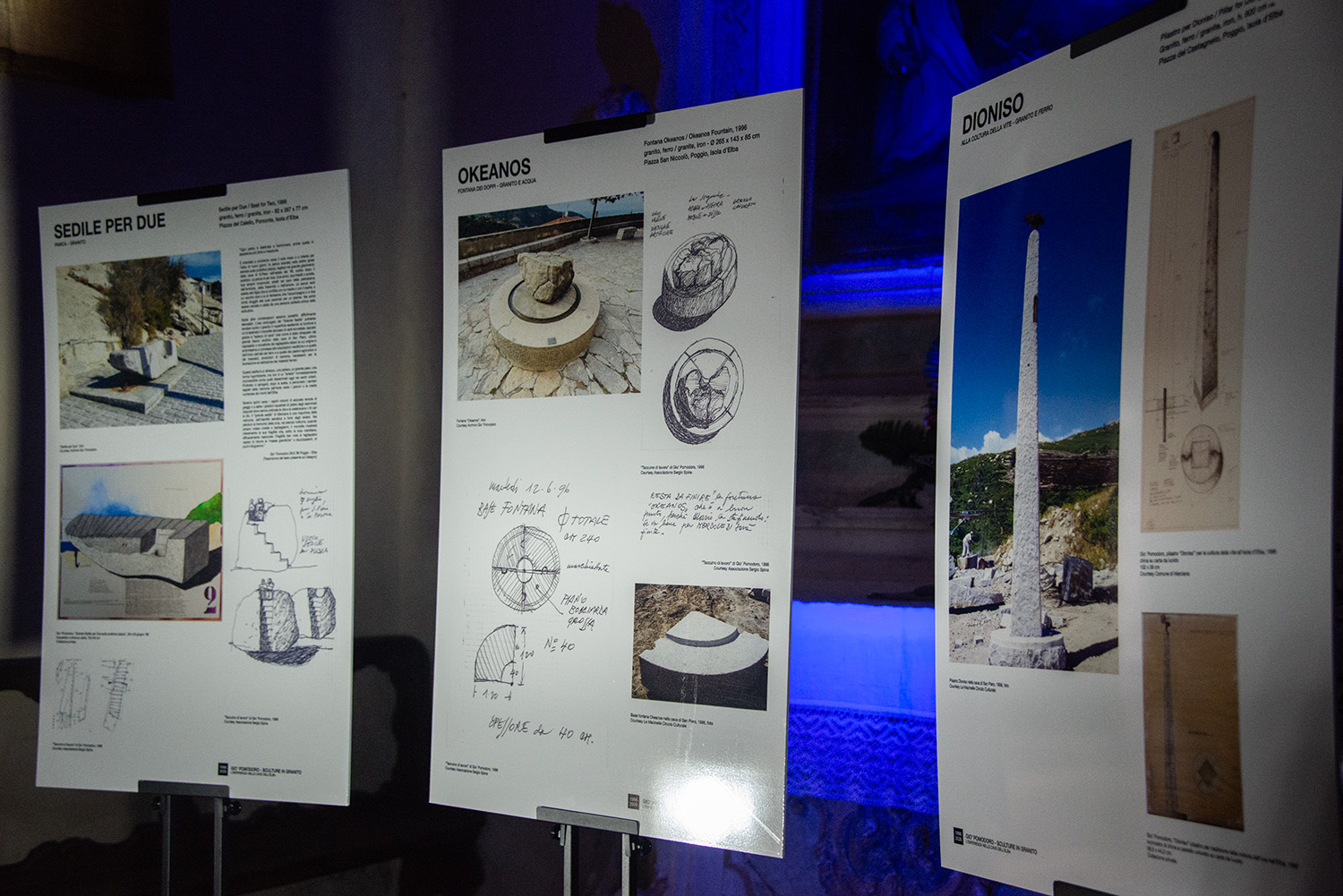
1) This year marks the 30th anniversary of Gio’ Pomodoro’s artistic creation on Elba. It was 1996 when Gio’ Pomodoro was invited to the island of Elba for an exhibition project. The artist created a series of monumental granite sculptures dedicated to the islanders and their memory. Four works remain on Elba from that summer spent between the San Piero quarry and the village of Poggio: the Dioniso pillar, the Okeanos fountain, the Sedile per Due (Seat for Two), and the Tavola degli Antenati (Table of the Ancestors).
Sculptures and Testimonies to Celebrate 30 Years of Work on the Island
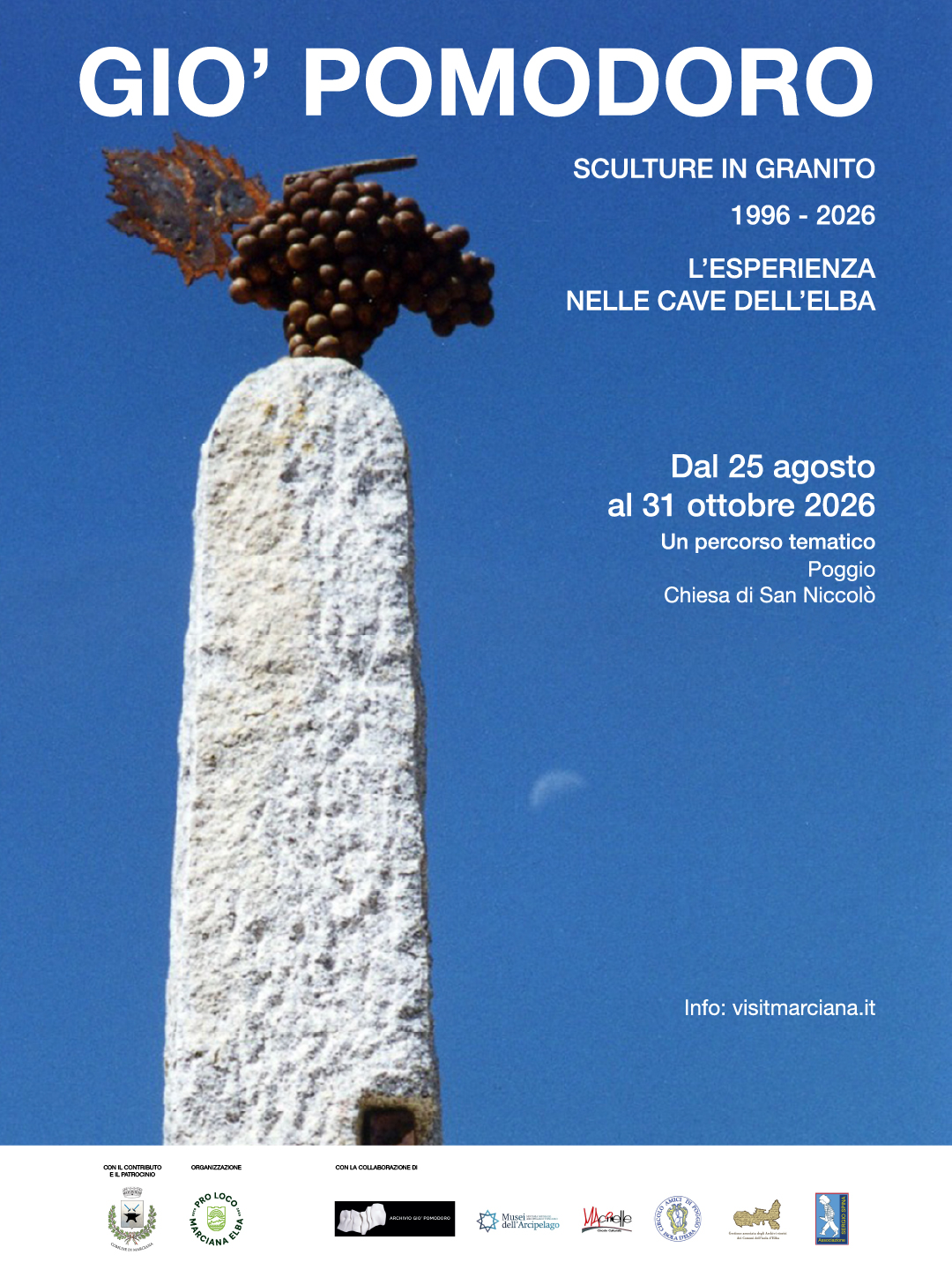
The Municipality of Marciana and the Pro Loco Marciana Elba have organized an event to engage the public in a narrative exploring Gio’ Pomodoro’s relationship with the island. This thematic itinerary—running from August 25 to October 31, 2026—unfolds across the large granite sculptures in Poggio and Pomonte, an exhibition in the Church of San Niccolò in Poggio, and a video testimony.
The exhibition is the result of local research that gathered numerous unpublished materials from Gio’ Pomodoro’s summer on Elba, including original drawings, photos, watercolors, and handwritten texts by the master. Additionally, a video featuring short testimonies has been produced. The goal is to fill the information gap surrounding that experience, enriching the perspective and understanding of Pomodoro’s Elba works with new insights. This result was made possible thanks to valuable collaborations with local associations and private collectors on Elba.
As Rossella Farinotti, executive director of the Gio’ Pomodoro Archive, reminds us, “the places sculpted and the site-specific works created by Gio’ Pomodoro have always analyzed various themes related to the community, history, and aesthetics of the territories in which they were created. Before producing a work, the sculptor conscientiously and knowledgeably investigated every detail and experience, paying special attention to local materials and drawn to those who knew how to work them with mastery. The four sculptures created for Elba represent archeologies of the island and tributes to the granite quarrymen of the San Piero quarry. This is the stone that Pomodoro uses, along with iron, to create the works featured in the exhibition, whose prior development can be discovered through the artist’s notes and precious drawings.”
Events and Locations
- Tuesday, August 25 at 6:30 PM: Opening of the thematic itinerary at the Church of San Niccolò in Poggio.
- Wednesday, August 26 at 9:30 PM: Presentation of the video and the full research project at the Pisane Fortress in Marciana.
Gio’ Pomodoro’s sculptures Dioniso and Okeanos are located in Poggio, while Sedile per Due can be found in Piazza del Calello in Pomonte. The Tavola degli Antenati is currently at the San Piero quarry awaiting restoration.
________________________________________
2) The Story of the Island – Rossella Farinotti
The sculpted places and site-specific works created by Gio’ Pomodoro have always explored various themes related to the community, history, and aesthetics of the territories in which they were created. Before producing a work, the sculptor conscientiously and knowledgeably investigated every detail and experience, paying special attention to local materials and drawn to those who knew how to work them with mastery. Okeanos (the fountain of the doubles), Dionysus (dedicated to the cultivation of the vine), Luna (the guardian of Mnemosyne), Lamos (dedicated to fishing), Table of the Ancestor (dedicated to stonecutters and blacksmiths; to granite and iron), Seat for Two (for the resting of the people): the five sculptures created for Elba represent archeologies of the island and a tribute to the granite quarrymen of the San Piero quarry. This is the stone that Pomodoro uses, along with iron, to create the works featured in the exhibition, whose prior development can be discovered through the artist’s notes and precious drawings. Gio’ Pomodoro was meticulous not only in working with materials, but also in recording the processes of data collection, experiences, and production. In his handwritten notes, for example, there is a nine – point list where the sculptor summarizes the final actions for closing the works on Elba – practical annotations that reveal his meticulous attention to detail and his dialogue with the stakeholders involved (iron production, granite splitting, etc.).
How can one leave a trace that, from aesthetic, ethical, and historical standpoints, reflects a place and its narrative? How can one develop a sculpture for collective use, contemplation, dialogue with the territory, and even for rest? How can one act with care and precision in using materials while also extracting their force and energy? These remain open questions in contemporary art that serve as valuable tools for reading Gio’ Pomodoro’s works. These themes were thoroughly investigated by the sculptor and applied to his practice time and again. Indeed, Pomodoro operated by reworking stories absorbed during his explorations and inquiries, translating them in his signature style into works crafted from the typical materials of the places where he was invited to interact through his thought and art-making.
Pomodoro often worked with complex materials, recontextualizing them at their source while highlighting their power and preciousness. Regarding the granite and iron extracted on the island, for instance, his notes address the irreversible loss of their skillful craft. This is equally true for marble – a precious material Pomodoro used extensively, sourced from quarries ranging from Carrara (the sculptor’s studio-home in Querceta was even dedicated to the stonecutters who originally lived there to work the quarries) to Belgium and Portugal. Then came bronze and resins (which Gio’ used as early as the 1950s, when plastic was an avant-garde material).
On the island of Elba, Pomodoro discovered that granite and iron were not only part of the territory’s DNA since ancient times, but that their processing and very existence were gradually disappearing. In the summer of 1996, the sculptor acted as a scholar during a “brief holiday” – as he defined it in his detailed notes – putting it to good use by creating five symbolic in-situ compositions that have settled on the island like rigorous fragments of a territory. Like an explorer connected to the land, Pomodoro traced a personal path that, years later, is rehabilitated through this exhibition project and the analytical passion of those who developed it. Memory must be perpetuated; values exalted; possibilities and details investigated and locked in memory -just as Gio’ Pomodoro approached time and space, here engraved in stone and iron.
The themes addressed by Pomodoro in his Elban adventure are varied and merge with core conceptual principles of his sculptural practice: the mutation of nature contrasted with the irreversible consumption of matter by humanity, as well as the skilled preciousness of artisan labor. It is a continuous loop, akin to the Ouroboros biting its tail—referencing a body of work by Pomodoro where beginning and end coincide. Gio’ Pomodoro always had a soft spot for those who possessed the experience to work the land. On Elba, in particular, he wrote about the importance of the traces left in the landscape and the Mediterranean scrub by shepherds, farmers, miners, and stonecutters. “The memory of fundamental human civilization activities will be threatened here as well,” the sculptor warned, emphasizing how much places have been shaped by humanity and how vital it is to preserve the traces of labor. Sculpture serves as a powerful testament because each piece encapsulates multiple stories, experiences, mythologies, symbols, water, fire, and acquired virtuosity—elements that, in Pomodoro’s sculptures, remain in perpetual motion despite being set in material fixed in time.
3) A Heart of Stone for Gio’’s Island – Gaspare Barbiellini Amidei
ISLAND OF ELBA – Sometimes, on a journey to the center of one’s own memories, one also happens to rediscover the path of others’ memories. Having returned to my island from a distant and very different land, where I have been living for a few years, I saw Elba protected in its memory through the care of one of the greatest contemporary artists. He came here and restored to the island’s inhabitants, through their own granite, some of the symbols and balances that commercial modernity dissipates. The tourist who turns their back on the sea for an hour and climbs through a sudden chestnut grove to the village of Poggio will discover this summer the tribute that Gio’ Pomodoro wanted to pay to the island. Anyone who knows Elba well knows that each of its villages has its own code, its own golden ratio: there is a harmony among the spaces, the heights, the materials used, and the utility of every single artifact – fortress, church, home, granary, watchtower, and defense tower. This island away from the sea is a surprise for vacationers and a refuge from the inevitable dispersion of holidays. In the midst of this alternative Elba, Gio’ Pomodoro has reinvented and then installed sculptures that tell the story of his geometric poetry as an artist while proposing a synchronicity between his invention and the collective imagination of the Elban people. Long before the Etruscans, Romans, Spaniards, Pisans, Florentines, and the English, since prehistoric times, they sculpted a landscape, an agriculture, an architecture, and a detailed urban design with artisanal and peasant wisdom.
You have to see it to understand. Every alley and every path is a small part of a stage in the theater of memory. They tell stories, legends, and mysteries. Medicean Portoferraio has its own major mystery, so perfect and impregnable is its core of fortresses; the castle of Volterraio, a stone falcon perched on a mountain, carries a fascinating and hardly believable legend. San Piero, Sant’Ilario, Rio Castello, Capoliveri, Marciana, and this village of Poggio evoke a hundred secrets, as well as the shared ability to evade the ancient Barbary raids and modern noise intrusions. Here, just as with the granite in the quarries of San Piero, it is easy to engrave deep into memory, to dig into the center of recollections, and to take notes—just as I did when setting my latest romance novel on Elba; a novel I didn’t write, Elba wrote it.
I believe that the same phenomenon of psychological inflation with the territory happened to Gio’ Pomodoro. So ancient and yet so modern, so singular in their arcane harmony, his sculptures were already contained within the granite quarries where he worked in the spring. On Elba, everything holds together, or at least everything once did. The shepherds, farmers, miners, and stonecutters who have inhabited the island since the Neolithic period knew—just as an artist like Pomodoro still knows today—that every gesture, every labor, and every thought needs a center around which to harmonize. They also need a root, without which life has no meaning. If you cut it the right way with the ancient wisdom that Pomodoro would like to save for future generations, if you cut the granite without ruining it, you discover that its veins are a sedimentation of memory, petrified roots. Splitting granite and harvesting grapes shared the same rhythms; both helped one to act and to think.
Pomodoro says: “Since time immemorial, the practice of stone-splitting granite here was one with sheep farming, vine cultivation, and iron extraction. Today, those shepherds, farmers, and stonecutters are rare presences, condemned to disappear. The last goat herder on Elba, named Evangelista, 72 years old, gave up his herd just a few days ago.”
The artist recounts: “In the quarries of San Piero, where I work with the last Elban stonecutters, nothing offers hope for a fate for granite craftsmanship better than that of sheep farming. What was a certainty for centuries will be swallowed up by the coppice woodland, just as already happened to the vineyards that once covered every hill and slope.”
Perhaps it will not turn out this way, precisely thanks to these sculptures scattered across the small squares of Poggio, almost like archaeological finds: a fountain, an obelisk, a table for stonecutters and blacksmiths, a seat for two, and several symbolic compositions. These works by Pomodoro are a challenge to the irreversibility of the island’s wasteful turn in history, to the erasure of memory and its alchemical center. The most alchemical of contemporary artists, Gio’ Pomodoro, reminds us with these creations that the philosopher’s stone exists and must be worked. He reminds us that the gold lies in the minds of those who continue to make these stones speak by cutting them in the quarry, and of those who know how to recognize them afterward. Without taking anything away from its progress and tourism, Elba will not lose itself if it manages to preserve and revive its stones, its fields, and its crafts.
Come see for yourselves by going up to Poggio. Pomodoro might seem pessimistic, but he is not, considering he went into the quarry after all: “Elba’s memory is about to be erased by the Mediterranean scrub. I have tried to collect a few fragments of it for a brief summer.”
With these “collected fragments,” the Elban summer could instead last for centuries to come. The mainland of forgetfulness is somewhere else entirely.
4) Seat for Two – Gio’ Pomodoro [Text transcription from the drawings]
Every stone is destined to shatter, even the one that appears to be the strongest and most massive.
Facing west toward the red sun or east toward the dawn of new days, the bench hollowed out of igneous stone rests stranded in the public square, cut from the great deposit of the San Piero quarry in the summer of ’96, right after the solstice. The bench is for two. Two friends, two brothers or sisters, two lovers in love, held close within the hollow of the stone-boat of friendship, fraternity, or love. The bench will suit a daughter confiding in her mother or father, a lonely old person and a ghost keeping them company, or two children who have escaped parental care for a moment. But it might also be sought out and used by a solitary person who is a friend of solitude. Many other combinations will be possible, hard to list. Prolonged use of the “great seat” could polish the granite on the surface, enhancing the function intended for this monolith weighing several tons, left rough and “quarry-split” just as it was ripped from the massive eruptive deposit of the San Piero quarry—the last stronghold or bastion of Elban stonecutters, whose origins are ancient and bound to Neolithic populations, the early Iron Age, shepherd-farmers, and woodcutters who produced the charcoal necessary for extracting and working iron.
This seat is a tool, a raft, a great weight, a cumbersome shape, but it is not a piece of “furniture” immediately recognizable like those scattered through urban centers today. Rather, after a pause, it will prompt us to walk the island’s secret paths of memory toward the plateaus or numerous mountain ridges of Elba. We will be drawn toward the round caprili—stone shelters for remote flock gatherings—or to climb the square stone steps of the endless ziggurats where vines were cultivated and rituals dear to the god were celebrated. The “great seat” of Marciana is a machine of memory, built of the wild, resilient identity of the islanders. Under full moons as the moon sets, in the silence of the night when screech owls and barn owls love to fly, the monolith will reveal all its fragility, which it effectively hides under the midday light—a fragility well known to the stonecutters, who are capable of reducing “granite masses” to mere toothpicks weighing just a few kilograms.
5) Table of the Ancestors
A work originally located in Pomonte: after being damaged by a storm surge in the early 2000s, it was transferred for restoration to its original quarry in San Piero.
6) Granite and Iron – Gio’ Pomodoro [Text transcription from the drawings]
Here right before my eyes lies the treasure of the quarry.
Just raw, split matter-the shapes of the quarry blocks like large, fragrant chunks of Parmigiano Grana, ready to be served intact under the dazzling sun. Violent nuptials are celebrated between iron wedges and granite boulders, officiated by the stonecutters. After cutting blocks weighing as much as 30 to 40 tons from the massive natural deposits of ancient eruptions, they carry out the splitting operations with iron wedges and sledges through extreme skill and consummate mastery.
This ritual is violent, for it violates the very heart – profoundly dark and silent – of the stone, which fire produced in the crucible of the planet’s depths. Light bursts in with an explosion of brilliant sparks, a shimmer of quartz crystals and mica from the great geological mixture, as the boulder splits inexorably: a single unit divided, cut in two. The nuptials are fatal for the rock.
7) The Memory of the Island – Gio’ Pomodoro
Visible – even if adrift, already beyond the threshold where extinction is irreversible – are several fundamental, historic activities of the inhabitants of the island of Elba. Visible because they are inherent to the landscape, so deeply have these human activities marked its territory. Since time immemorial, the practice of splitting granite has been one with sheep farming, vine cultivation, and iron extraction. Shepherds, farmers, miners, and stonecutters have populated Elba since Neolithic times. Reduced to a rare presence, their descendants are condemned to disappear forever.
Of this, the goat herder Evangelista is well aware; at seventy-two, he gave up his herd just a few days ago. I met him in his caprile this morning, melancholic and sad, absurdly dressed in his U.S. Marine camo jumpsuit, consumed by avowed nostalgia for his lost herd and by the consciousness of the end. In the San Piero quarry, where I work with the last Elban stonecutters, nothing offers hope for a fate for granite craftsmanship better than that of sheep farming.
What was a certainty for centuries will be swallowed up by the coppice woodland, just as already happened to the vineyards that once stretched across endless ziggurats on every hill and slope of Elba.The memory of fundamental activities of human civilization will be threatened here as well. The identity of the island’s current population is at an irreversible turning point, having reached the completion of an anthropological mutation that began sixty years ago, no earlier.
Here it is dramatically visible – much as elsewhere, in big cities, people believe it should not happen – yet it occurs right within these sanctuaries of wildness, to which Elba rightfully belongs, as tourist agencies like to claim. The memory of Elba is about to be swallowed up by the Mediterranean scrub. I have tried to collect a few fragments of it for a brief summer.
8) Gio’ Pomodoro (1930-2002)
Gio’ Pomodoro was born in 1930 in Orciano di Pesaro. He completed his military service in Siena and Florence, where he frequented the artistic circle of the Galleria Numero, and in ’54, he moved with his family to Milan.
Here, he exhibited alongside his brother Arnaldo at the Galleria del Naviglio. In 1956, he was invited for the first time to the Venice Biennale, where he presented works created from 1954 onwards: silver casts on cuttlebone dedicated to the poet Ezra Pound. He began collaborating with the journal Il Gesto and participated in exhibitions of the “Continuità” group with his brother, Fontana, Dorazio, Novelli, Perilli, Tancredi, and Turcato. In 1958, his solo exhibition at the Galleria del Naviglio was presented by Gio Ponti. During this period, he detached himself from the group organized around Il Gesto and began the Fluidità contrapposta (Opposing Fluidity) series, which he exhibited at Documenta II in Kassel in 1959. From 1958, he worked on the Superfici in Tensione (Surfaces in Tension), winning the sculpture prize alongside Anthony Caro at the first Biennale for Young Artists in Paris in 1959. In 1961, he held a major exhibition at the Galerie Internationale in Paris, and in 1962, he exhibited at the Galleria Blu in Milan and at the 31st Venice Biennale with a dedicated solo room. In 1964, the Tate Gallery in London acquired his work One. The artist created several large works from the Folle (Crowds) series, and from 1965, he began working on the Radiali (Radials) and Quadrati (Squares). In the two-year period 1966–67, following travels to the United States, he executed Black Liberator, dedicated to Black Americans.
From then on, for the next ten years, Gio’ favored stone and marble, transforming tensions into torsions. He began the series of Archi (Arches), Soli (Suns), and Contatti (Contacts), which he created in his studio in Querceta, Versilia. In 1974, these new cycles were exhibited at the Galleria del Naviglio in Milan and in his first anthology exhibition at the Loggetta Lombardesca in Ravenna, followed two years later by solo shows at the Castello dell’Imperatore in Prato and the Musée d’Ixelles in Brussels. In 1977, he created his first major public work, Piano d’uso collettivo (Plan for Collective Use), born from a collaborative project with the residents of Ales in Sardinia and dedicated to Antonio Gramsci. In 1978, he designed the set for Verdi’s opera La forza del destino, performed at the Arena di Verona, and set up a solo room at the Venice Biennale. In 1979, he began designing the monumental work Teatro del Sole – 21 Giugno, Solstizio d’Estate (Theater of the Sun – June 21, Summer Solstice), a square – fountain dedicated to Goethe for the city of Frankfurt.
In 1980, he designed the set for Mozart’s The Magic Flute, staged at La Fenice in Venice. In 1984, he was again present at the 41st Biennale, and an anthology exhibition opened in the rooms of Palazzo Lanfranchi in Pisa. From his study of Károly Kerényi’s texts on Greek myth and religion, the Hermes cycle was born, presented at the Palazzo Civico in Lugano in 1985. That same year, the work Montefeltro, i passi e il volgersi was installed at the Villa La Favorita in Lugano. In 1989, the artist presented an important solo exhibition at the Rotonda della Besana in Milan, curated by Guido Ballo. In the same year, the bronze sculpture Sole Aerospazio (Aerospace Sun) was installed in Piazza Adriano in Turin.
In 1991, in Taino on Lake Maggiore, the monumental complex Luogo dei Quattro Punti Cardinali (Place of the Four Cardinal Points) was inaugurated. In 1993, the Genia Schreiber University Art Gallery in Tel Aviv hosted a solo exhibition of the sculptor, and his work Scala Solare – Omaggio a Keplero (Solar Ladder – Homage to Kepler) was placed in front of the university. In 1994, he was invited to participate in the exhibition “The Italian Metamorphosis, 1945–1968” at the Guggenheim Museum in New York. In 1995, he exhibited his most significant works in England at the Yorkshire Sculpture Park, and in 1996, he presented sculptures and large watercolors in the Sala d’Arme of Palazzo Vecchio in Florence. From 1995 to 1997, in collaboration with the Arezzo goldsmith company UnoAErre, five major international anthology exhibitions dedicated to jewelry were held under the title “Ornamenti 1954 – 1995”: in 1995 in Venice at the Querini Stampalia and in Arezzo in the Lower Basilica of San Francesco; in 1996 in Tokyo at the Ginza Cloisonne Hall and in Vienna at the Kunsthistorisches Museum; and finally in 1997 in New York at the Museum of the Fashion Institute of Technology. In the summer of 1996, Gio’ was invited to the island of Elba to create several monumental works in granite (sourced from the San Piero quarry) and iron; four sculptures titled Pilastro per Dioniso, Okeanos, Sedile per due, and Tavola degli Antenati were left on the island for the community. As a guest of honor, he participated in the 7th Cairo Biennale in 1998, and in Genoa in 2001, he inaugurated the work Sole – agli Italiani nel mondo on the Molo dei Mille. In 2002, Gio’ Pomodoro received the Lifetime Achievement Award in Contemporary Sculpture. He passed away in Milan in December of that same year.
In the years following his death, several public works designed by the sculptor for the community were inaugurated: in 2003, Vela in Sestri Levante; in 2004 in Orciano di Pesaro, the square he designed in 1986 along with Sole deposto; and finally, in 2005, Frammento di vuoto in Carbonia.